

In the mid-2000s, one of the more notable early viral moments online was when Oprah Winfrey “gave away” almost 300 new cars to her studio audience in a surprise giveaway. Watching the clip below, one can feel the excitement and joy as they opened the gift boxes to discover a set of keys to a brand new vehicle. Later, many winners were upset to learn that these vehicles were considered income under the IRS rule of gift taxes.
As this article notes, some producers were somewhat shocked at the audience’s reaction to news that they were now on the hook for paying the gift tax.
Speaking on the podcast, looking back on the show, producer Lisa Erspamer reflected on the backlash.
“Because the Pontiacs were gifts, they were taxed as ordinary income, and this also meant the gift tax had to be paid by the person receiving the gift.”
The show’s producers, to their credit, paid for the sales tax and registration of the car, but obviously, they couldn’t pay everyone else’s taxes.
“And because we didn’t pay the gift tax, people complained to the press, and that was devastating. We put our whole soul into this moment of television and with real intention to do something good, and so when people had a negative reaction, it literally hurt our feelings.” {Bold added for emphasis}
It “hurt their feelings” not being appreciated for handing over nearly 300 additional tax burdens wrapped up in a nice gift box. The producer still shows a sense of obliviousness over 20 years later to why there was a backlash.
As the “You Get A Car!” GIFs and memes occasionally make an appearance online, a larger lesson in this 2000s pop culture moment on a drawback of instant altruism were mostly an afterthought and highlight a problem that persists today on the larger geopolitical scale of US foreign aid. The “Oprah Car Surprise” repeats itself in an endless loop.
American geographical altruism knows no bounds. Right now all, across the globe there are tens of thousands of little projects going on under the direction of either NGOs, foreign aid funds and many other private institutions doing their part. Whether food aid, habitat building, or the latest Bill Gates vaccine program in India, American tax dollars are hard at work to make the world a better place.
Allegedly.
To be sure, there is probably a group of bright-eyed Mormon kids, brimming with optimism currently putting a roof on a house in Guatemala right now.

Changing lives, amirite?
I’ll admit, there was a time in my youth where I had moments of believing all these efforts to improve conditions in Third World countries was entirely worthwhile and with zero downsides. There was also a time when I still believed in Santa Claus and the Easter Bunny.
"Give a man a fish and you feed him for a day; teach a man to fish and you feed him for a lifetime"
The African Time Bomb

President Biden was in Africa last week doing Biden things; falling asleep, apologizing for slavery, and promising billions of American tax dollars to the continent. Also dancing with the locals. The usual stuff. Count ourselves lucky that he didn’t
Traveling the world allows one to experience the realities behind the constant noise and media depictions of how things actually are in many 3rd world nations.
During deployments in the military, there are opportunities to participate in what they call COMREL projects. (COMREL stands for community relations. The military loves acronyms for everything.) Basically, a group of volunteers would help an impoverished village build or repair some infrastructure, usually a playground or spruce up an orphanage. Medical personnel would go to the village hospital and assist whatever NGO who ran the clinic and the few locals who worked there.
Over time, a system of dependence would form. The term Learned Helplessness was not in my lexicon to be able to describe what I witnessed at the time, but it nicely fits what would occur in these areas of the world that continuously received Western assistance.
Best example was hearing about a playground getting repaired in the Philippines multiple times over numerous deployments. They would essentially let it fall apart and wait until the next US military detachment showed up. It was more than simply adding a new coat of paint or changing the basketball netting. Conditions would get pretty bad in between; jagged edges from playground parts long cut off by villagers for.. something, slides and swings not secured to the ground anymore due to bolts getting removed, etc. Worse was hearing of an orphanage that simply let the roof leak until the G.I. Joe Home Depot showed up to fix it again.
Behind the official glossy photos of smiling little orphans and repaired equipment touted by NGOs and media outlets and gov’t PR, the hidden frustration was in knowing it was only a matter of time before things would fall into disrepair again.
These distant memories of geographical altruism came to mind as I listened to a recent NPR episode on the PEPFAR program, its effectiveness, and the possibility of a complete dismantling of the program by the Trump administration. PEPFAR was announced with great fanfare in 2003 by then-President George W. Bush as a crisis response to combat the ravaging effects of the AIDS virus in Africa.
The NPR guest was Doctor Deborah Birx, former US global AIDS coordinator for the PEPFAR initiative from 2014 to 2021. Her experience with the AIDS epidemic in Africa goes back to the 1980s and I expected to hear concrete results and arguments as to why this 20+ year “temporary crisis program” needed to remain funded.
That was not what happened.
Anyone familiar with the NPR interview format can surmise how this sit down went with a supposed leading expert in her field and of the PEPFAR initiative. It was the usual softball-style interview with plenty of flowery language and word salad moments where Dr. Birx waxed poetically about how proud she was that the program was started, and about how 26 million Africans were dying naturally instead of from a deadly and preventable sexually transmitted disease.
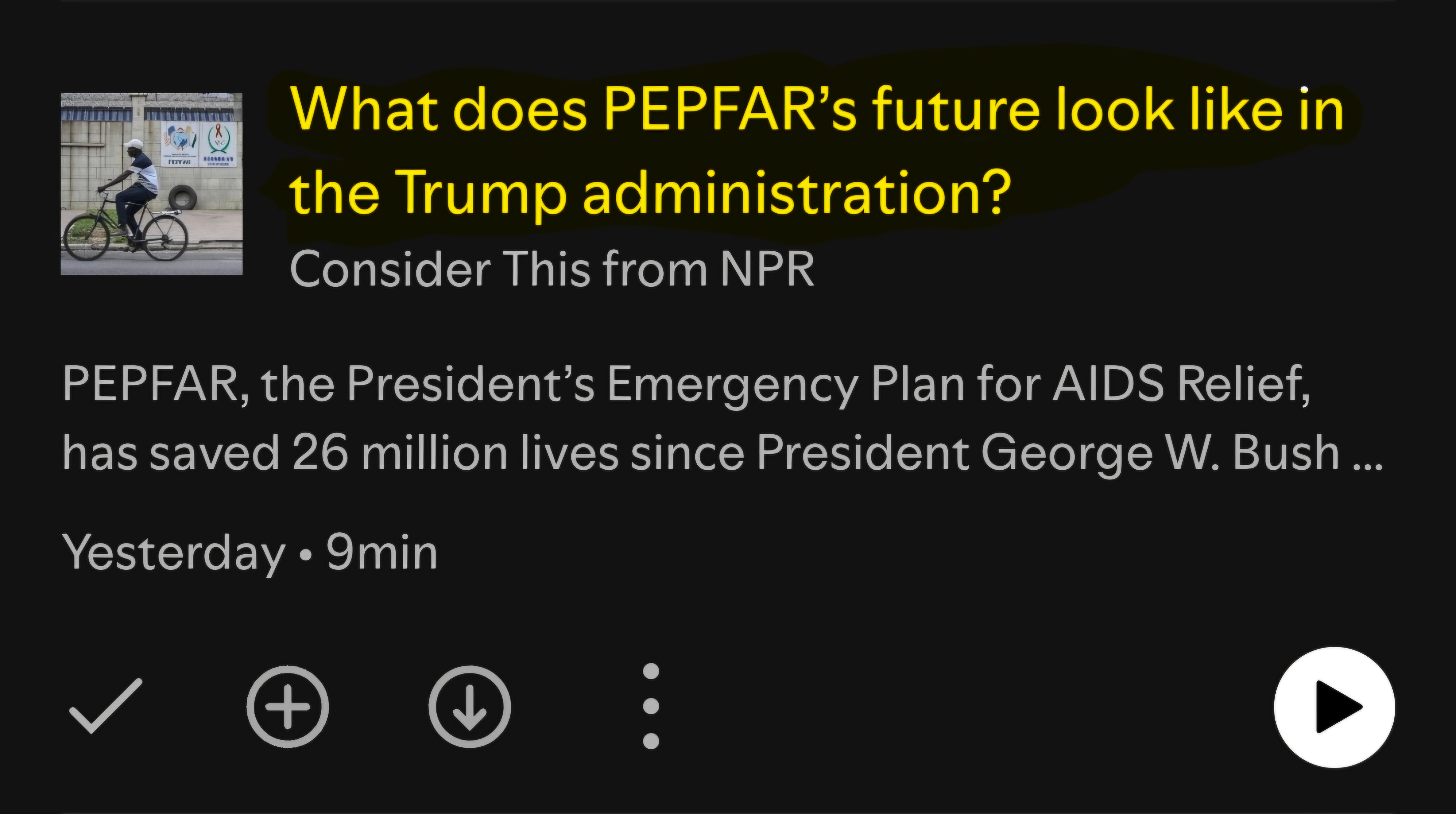
Obviously, those 26 million folks are grateful to be alive today and the treatment and prevention education wasn’t for nothing, but what, exactly, has PEPFAR accomplished?
Pretty much nothing.
Since the announcement of the PEPFAR initiative in 2003, over $120 billion dollars has been spent to treat and prevent the spread of HIV/AIDS in Africa. The program was designed from the beginning as a continual external support program in the efforts to eradicate HIV/AIDS in Africa.
Key word being external.
What does this mean?
This means that over 20 years and $120 billion American taxpayer dollars later, no pharmaceutical factories were built in Africa to produce HIV testing kits or treatment drugs.1
It means no dedicated medical centers or facilities were erected in support of the PEPFAR mission statement that include goals of “sustainability of the HIV response,” “country ownership,” and gradual transition to domestic financing and management.
Nor has there been a dedicated medical school pipeline to train native Africans to treat their own people.
Essentially, without ongoing funding the PEPFAR initiative falls like a house of cards. It was never meant to “enable” countries in Africa to eventually get on their own feet managing the AIDS epidemic with their own doctors, factories and facilities. It was more of a hand-out than anything that would be considered a helping hand. Instead of teaching them to fish, we simply handed out fish platters to the tune of $120 billion dollars. PEPFAR is another “Van Wilder-style” foreign aid program that will never accomplish its own stated goals and continue to bleed tuition taxes to keep people like Dr. Birx and other NGOs in the proverbial global college.

Does this mean there should be no efforts to improve the lives of those in the 3rd world? That the West has no role to play?
No, it doesn’t.
But just as the playground falling into a condition of jagged metal and rust, only to require constant upkeep from a benevolent source, doing things because it makes one feel good will not solve complex geopolitical problems simply by throwing money at it. In fact, it only makes things worse.
R/
Arthur
If you enjoyed this essay or other pieces of my work, you can show your support by Buying Me A Coffee.
For such a compassionate project such as eradicating HIV/AIDS in Africa, one would think pharmaceutical companies like Abbott Laboratories, (USA) Roche Diagnostics, (Switzerland/Germany) SD Biosensor Inc., (South Korea) Hologic Inc., (USA) and Cepheid (Danaher, USA) would be lobbying to have factories built in Africa. Alas, no.
Your excellent article is making me revisit RFK Jr's book The Real Anthony Fauci. The book has an extensive portion devoted to Fauci, AIDs and Africa, and relayed that you be diagnosed with or without AIDs depending on what country you were in, and those diagnostics were all vastly different from the diagnostic techniques and thresholds administered in the US. Somehow that didn't stop Fauci and apparently he shared this "success" with Dr Birx.
The American people are chided for being heartless with respects to charity, and yet we have lost trillions to causes for people we never see, nor can we ever ascertain if we made a dent in the issues that were relayed to us as requiring our wealth. It has bankrupted us.
A good analysis and summation of where we are in the world today. Way too many Americans want to 'do good' for non-Americans using other people's (tax-payers) money.